
Innovative Education
Education is evolving, and I’m passionate about pushing the boundaries of how people learn. I enjoy developing nontraditional teaching methods that bring learning to life inside and outside the classroom for all kinds of people, from K-12 students, college students, and working professionals. Whether it's a discussion about how you've implemented innovative education in your organization or how I can help you, let's chat!
The Day I Won an International Note-Taking Competition
I was watching a video with a sense of quiet appreciation. It lunch time on a school day when Samuel Suresh, a creator I’d followed for years, announced the winners of GoodNote's international note-taking competition, Think in Ink. As he went through the honorable mentions, I couldn't help but notice his keen eye for finding insightful things to say about each submission. Then came the drumroll, the moment for the runners-up, and that's when it happened. He said my name (and he said it correctly). In that moment, a feeling of pure elation and validation washed over me. I may have freaked out a bit.
In the age of AI, where large language models excel at generating endless streams of words, the power of a single, well-crafted visual note remains. While AI can explain a complex topic conversationally, there’s still incredible value in the visual element, especially in STEM subjects. My students agree—they’ve even encouraged me to compile my notes into a textbook. This competition was an opportunity to prove that visual learning isn't just aesthetic; it's a vital tool for true understanding.
The Project: Demystifying Breadboards
Watching Samuel's videos over the years has profoundly influenced my approach to thinking and teaching. By the time the competition launched in October, I was ready, having already honed my craft earlier that year (I challenged myself to create forty 1-page sketch notes for the forty days of Lent).
For my submission, I chose to create a visual note on breadboards—a topic that, ironically, I had excelled at in college through sheer compliance. I could follow instructions to get my circuits working for my electrical engineering classes, but I never truly grasped the underlying concepts. Now, in the first months of piloting my new engineering course, I needed a way to introduce this intimidating component to my students in an easy-to-understand way.
I dove into research, looking at complex diagrams, reading textbooks, and watching various videos. I even researched the history of breadboards to add a compelling, story-like element to the note. Distilling all those layers of information into a single, organized graphic was a fulfilling challenge that cemented my own understanding while crafting an invaluable resource for my students. This is what I came up with.
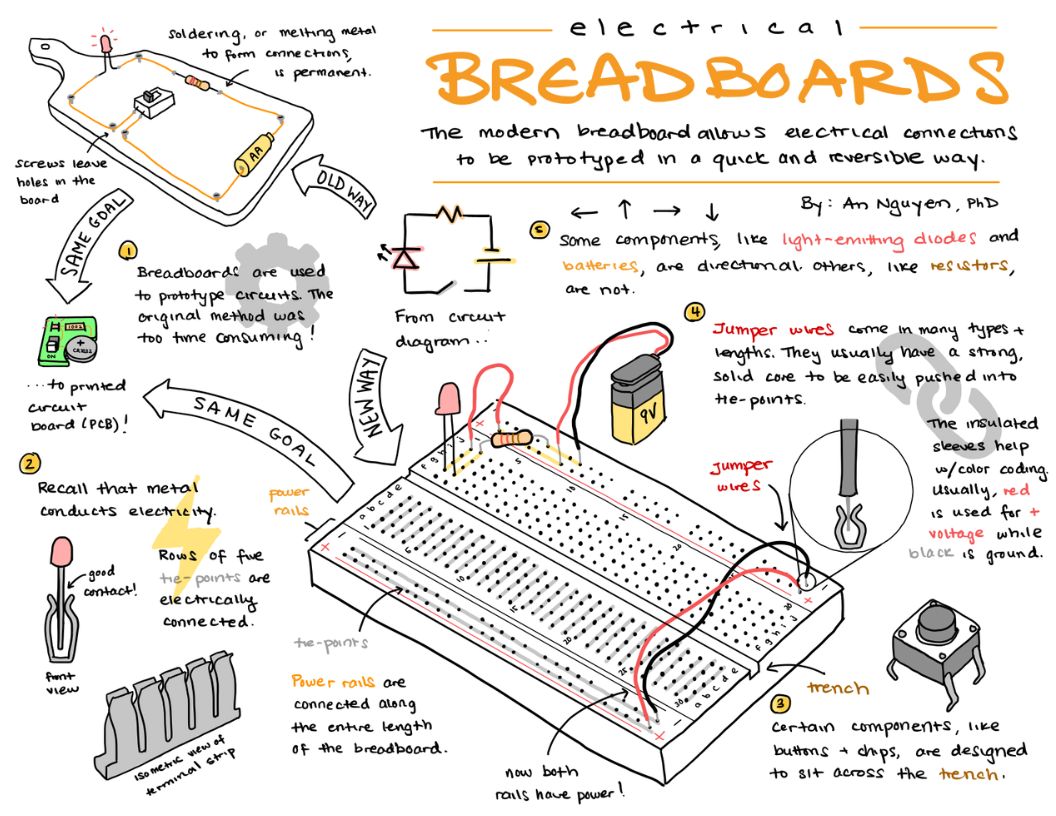
Caption: a single-page sketch note on breadboard basics.
From Competition to Classroom
The ultimate success wasn't the prize, as cool as a new iPad and Apple Pencil Pro are. The true win was seeing the note come to life in my classroom. My students used the graphic I created, and I observed how they used their knowledge of breadboards to troubleshoot their circuits. The note, born from my own struggle and a desire to help my students, was now a powerful teaching tool.

What Next?
Many organizations have a need for education: in K-12 schools, students need to master basic content in many areas; in colleges, students need to gain specialized knowledge; in the workforce, professionals need specialized training. I've worked in each of these areas to make education more effective using a variety of techniques that depends on the content, target demographic, and other constraints. I enjoy the challenge of making unique programs for a specific purpose and demographic.
- An Nguyen, PhD